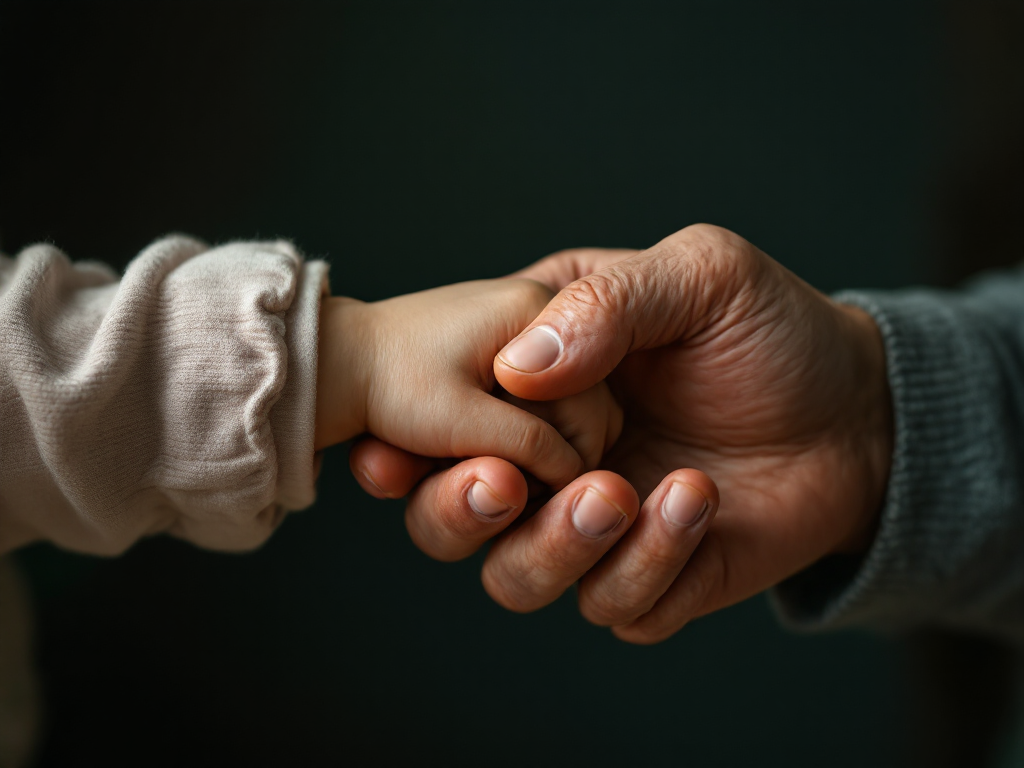
Grandparents live longer. But not because they are grandparents.
Why a Berlin study shows that caregiving reduces mortality risk — and why it requires no family relationship.
The Grandmother Hypothesis: Elegant theory, unsatisfying answer
There is an evolutionary theory that explains why women live for decades after menopause. The so-called Grandmother Hypothesis holds that postmenopausal women maximised their fitness by helping raise their grandchildren. Healthier, longer-lived grandmothers passed their genes on to more descendants — and so a longer lifespan became established.
Sounds plausible. But what does that mean today? And what exactly is the mechanism?
One of the most methodologically rigorous studies on this question offers a surprisingly precise answer. It is not grandparenthood itself that extends life. The active, caregiving role does.
What the study examined — and how
An international research team led by Sonja Hilbrand and David Coall, with participation from the University of Basel, the Max Planck Institute for Human Development, and Humboldt-Universität Berlin, analysed data from the Berlin Aging Study. Over 500 people between the ages of 70 and 103, observed over a period of nearly 20 years (1990 to 2009).
One methodological decision is particularly relevant. The researchers excluded grandparents who held primary responsibility for their grandchildren. The study examined exclusively occasional, non-custodial caregiving. The usual stepping in, not full-time upbringing. This restriction is not incidental. It is the key to interpretation.
The result: 37 percent lower mortality risk
Hilbrand et al. 2017 documented the following: grandparents who occasionally cared for their grandchildren had a 37 percent lower mortality risk than grandparents without caregiving responsibilities. The same effect appeared in comparison to people without grandchildren.
The association remained statistically stable after the researchers controlled for physical health, age, socioeconomic status, and characteristics of children and grandchildren. This is not a marginal effect. It is a robust finding.
The decisive point: Caregiving is the active ingredient, not the family tree
This is where it becomes particularly relevant for us as practitioners. The effect is not tied to family relationship.
The same analysis showed that childless older adults who supported others in their social environment also had a lower mortality risk. The authors hypothesise a neural and hormonal system originally rooted in parenthood. It is activated by caregiving behaviour in general. It promotes prosocial behaviour toward relatives and non-relatives alike.
Put differently: the system does not ask about the family tree. It responds to the action.
The honest nuance: More is not better
It would be a mistake to read this finding as an argument for maximum caregiving. The study's authors explicitly emphasise that a moderate level of caregiving produces positive effects. Intensive, sustained full-time caregiving, by contrast, generates stress load that takes a physical and mental toll. That is precisely why grandparents with custodial responsibility were excluded from the analysis.
This is not a footnote. It is a central finding. The dose-response curve is not linear. It has an optimum, and beyond that point the effect reverses.
It is also worth noting: this is an observational finding, not an experiment. Reverse causality is conceivable. Healthier people may simply be more able to help. The authors therefore speak of association — and that is how we should frame it in communication with clients.
What this means for health coaching
This finding fits into a picture that we at SLOW pursue systematically. Longevity is not a pure biomarker topic. Social integration, the sense of being needed, the experience of meaning, and the assumption of responsibility are all associated with hard endpoints. Anyone who excludes this dimension from health coaching overlooks one of the most powerful levers available.
Concretely, this means two things.
Think holistically: Caregiving balance, social role, and the subjective experience of meaning belong in the anamnesis. Not as an afterthought, but as part of the system. A client who has recently slipped into a caregiving role for a parent carries a different stress load than someone who looks after grandchildren once a week. Both are caregiving. The difference lies in degree and in control.
Stay precise: The individual situation determines where a person sits on this curve. Stress load, HRV, sleep quality, and self-reported social role need to be considered together. Not in isolation. Only the interplay of these data points produces a reliable picture.
In the SLOW platform, health professionals can integrate exactly these non-biochemical factors into a coherent assessment. Not because it sounds appealing, but because the evidence justifies it.
FAQ: Common questions about caregiving and longevity
Does grandparenthood generally extend life?
No. The study shows that the biological role is not what matters — what matters is the active practice of caregiving. Grandparents without caregiving responsibilities showed no comparably lower mortality risk.
Does the effect apply to people without grandchildren or children?
Yes. Childless older adults who supported others in their social environment also showed a lower mortality risk in the same study. Caregiving is the active ingredient, not family relationship.
Is more caregiving better for health?
No. The study shows explicitly that intensive, sustained caregiving — such as serving as the primary caregiver — is associated with increased stress load and cancels out the protective effect. The optimum lies in moderate, self-directed engagement.
How can I as a practitioner account for this factor when working with clients?
By systematically including social role and caregiving balance in the anamnesis and considering them alongside objective biomarkers such as HRV and sleep quality. Only the full picture allows for a precise assessment of actual stress load.
Source
Hilbrand S, Coall DA, Gerstorf D, Hertwig R. Caregiving within and beyond the family is associated with lower mortality for the caregiver. A prospective study. Evolution and Human Behavior, 38(3), 397–403 (2017). sciencedirect.com
Do you systematically include social role and caregiving balance in your anamnesis — and if so, how do you capture them? Write it in the comments.